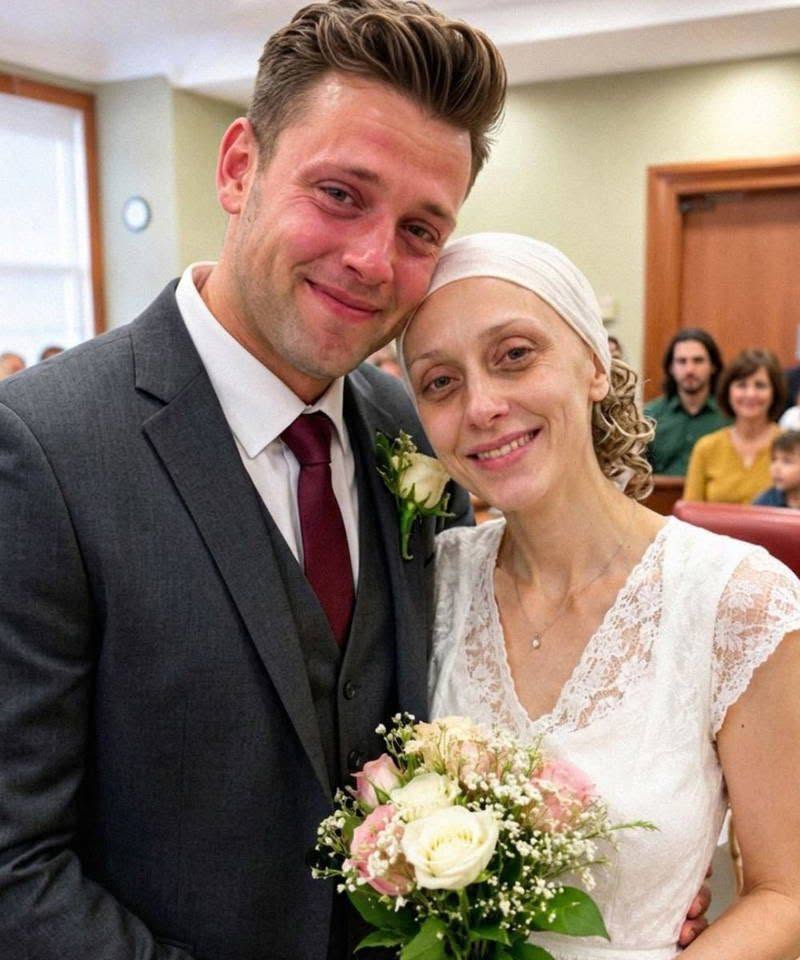
Ten years after the woman I loved vanished without explanation, she appeared at my door with one final request.
She was dying.
And she wanted me to marry her.
I thought saying yes would finally give me the answers I had spent a decade searching for.
Instead, five days after our wedding, Cara died—and left behind 127 letters revealing a truth that changed everything I believed about why she had disappeared.
PART 1
I met Cara during my first week of college.
She had taken my seat in a crowded sociology lecture and refused to move.
“You can sit beside me,” she said, glancing at my notebook, “but only if your handwriting is useful.”
I sat down.
By the end of that class, I was already falling for her.
For three years, we were inseparable.
We studied together, cooked terrible meals in tiny apartments, and spent Sunday mornings arguing over crossword puzzles.
Cara dreamed of owning an old house with green shutters.
I dreamed of graduate school, research, and traveling the world.
We believed somehow we could have both.
Then one evening, everything changed.
I had just been accepted into graduate school when Cara asked me a simple question.
“When do you think we’ll have children?”
I laughed nervously.
“Not for years. There’s still so much I want to do.”
Her face changed.
I thought she was pressuring me.
She thought I wasn’t listening.
The argument became ugly.
Neither of us apologized.
The next morning, her side of the closet was empty.
Her phone stopped working.
Her accounts disappeared.
Cara was simply gone.
I searched for her for ten years.
Not constantly.
But often enough that it affected every relationship afterward.
Then one rainy Thursday evening, my doorbell rang.
Cara stood on my porch.
She was thinner.
Pale.
Weak enough to grip the railing.
But I recognized her immediately.
“Hi,” she whispered.
I should have demanded an explanation.
Instead, I let her inside.
We sat across from each other.
Then she said the words I never expected.
“I’m sick. It’s terminal.”
I stared at her.
“How long?”
“A few months. Maybe less.”
Then she reached for my hand.
“I came here to ask you something.”
She wanted to marry me.
I actually laughed.
“You disappeared for ten years, came back dying, and now you want a wedding?”
“I know.”
“No, Cara. You don’t.”
Her fingers tightened around mine.
“Please.”
I should have refused.
Instead, two days later, we were standing inside a courthouse.
Cara wore a simple blue dress.
She was so weak that I supported her during the vows.
When the clerk pronounced us married, she smiled exactly like the twenty-year-old girl I remembered.
For five days, we lived inside a strange little miracle.
We ate breakfast in bed.
Watched old movies.
Listened to the rain.
Every time I asked why she had returned, she said the same thing.
“Later.”
There wasn’t enough later.
Cara died beside me on the fifth night.
At her funeral, as the casket was lowered, a woman I didn’t recognize approached me.
She placed an envelope in my hand.
Inside was a brass key.
“There are 127 letters waiting for you,” she said.
“Read the oldest one first.”
PART 2 The woman introduced herself as Mara.
She had been Cara’s roommate.
She drove me to the apartment where Cara had lived and led me into her bedroom.
Beneath a row of coats sat a dark wooden trunk.
“She wrote to you for years,” Mara said.
“Why didn’t she send anything?”
Mara looked at me.
“Because fear became her excuse.”
I opened the trunk.
Inside were dozens of envelopes bundled by date.
Every one had my name written across it in Cara’s handwriting.
The oldest letter had been written three days after she disappeared.
I opened it.
The first sentence stopped me cold.
I am pregnant.
Cara had discovered the pregnancy only hours before our final argument.
When I talked about graduate school, Europe, and waiting years before having children, she panicked.
She convinced herself that telling me would destroy my plans.
So she went to her mother’s house, intending to return once she knew what to say.
She never got the chance.
Complications ended the pregnancy.
The next letter described a hospital room and Cara facing everything alone.
One sentence read:
I lost our baby. Then I lost myself.
After that came years of letters filled with plans she never completed.
I’ll call tomorrow.
I bought a train ticket.
I found your office number.
Every time, fear won.
Too much time had passed.
I would hate her.
I had probably moved on.
Then the letters became even harder to read.
Cara knew where I lived.
She knew when I changed jobs.
She even knew when relationships ended because mutual friends unknowingly gave her updates.
Twice she traveled to my city.
Twice she came close to my home.
Twice she turned around.
“You knew this?” I demanded.
Mara nodded.
“I tried to make her contact you.”
“But you let it continue.”
“I couldn’t make that decision for her.”
Over the following days, Mara showed me places Cara had mentioned in the letters.
A diner where she once dialed half my number before hanging up.
A park bench where she sat holding my number on a napkin.
An apartment building where she once saw me walking inside with Elise, a woman I dated for eight months.
Cara assumed I was happy and decided not to interfere.
“She didn’t know Elise left because I couldn’t stop thinking about her,” I said.
Mara looked down.
“No. Cara never knew.”
Our final stop was our old college campus.
Behind a loose brick near the greenhouse, I found a small metal box.
Inside was an ultrasound photograph.
And Cara’s final letter.
She wrote that she had not returned because she expected forgiveness.
Her diagnosis had simply forced her to recognize how much of her life had been controlled by fear.
She refused to let fear make one final decision.
She came back because I was still the only person she could imagine spending the rest of her life with.
“Five days were never meant to replace ten years,” she wrote.
“They were the only honest days I had left to offer.”
I held the letter in my hands.
“I wish she had trusted me.”
Mara answered quietly.
“So did she.”
PART 3 It took me three weeks to finish all 127 letters.
Some made me miss Cara so badly I could barely breathe.
Others made me furious.
She had loved me.
She had also hurt me.
Neither truth erased the other.
One afternoon, Mara asked:
“Do you hate her?”
“Sometimes.”
“Do you forgive her?”
“Sometimes.”
Mara nodded.
“Anything simpler would probably be a lie.”
Eventually, I copied every letter and arranged them chronologically into a private book.
The original letters remained locked inside Cara’s trunk.
I wrote one sentence at the beginning:
Love can be real and still fail people terribly.
Then I contacted our old college.
I arranged for a copy of the letters to be stored privately in the archives under restricted access.
Not because I wanted strangers reading Cara’s pain.
I wanted a record of what fear and silence could cost.
Then I created something else.
The Open Door Fund.
It provided emergency assistance to students dealing with pregnancy, serious illness, medical emergencies, or situations where they felt they had nowhere safe to turn.
About a year later, an application arrived from a student named Lena.
She was pregnant.
Her family had threatened to abandon her if they found out.
Near the bottom of her form, she had written one sentence.
I do not know who I can tell safely.
The committee approved her request.
A few days later, I met Lena near the greenhouse where Cara and I had once spent so much time.
She sat nervously on a bench, twisting a bracelet around her wrist.
“Am I in trouble?” she asked.
“No.”
“Did I do something wrong?”
“No.”
I handed her the approval paperwork.
She read it and covered her mouth.
I didn’t tell her about Cara.
I didn’t tell her about the pregnancy Cara had hidden.
Or the 127 letters.
Or the ten years we lost because she believed she had to make every impossible decision alone.
I simply said the words I wished someone had said to Cara all those years ago.
“You don’t have to decide everything by yourself.”
Lena looked at me.
And in that moment, I finally understood what I could do with the years Cara and I had lost.
I couldn’t change her choices.
I couldn’t recover the decade that disappeared between us.
I couldn’t give us more than those five final days.
But perhaps I could make sure someone else knew there was still an open door before fear convinced them to disappear.
Cara’s silence had cost us ten years.
I couldn’t undo that.
But maybe her story could keep someone else from losing the same.


0 commentaires:
Enregistrer un commentaire