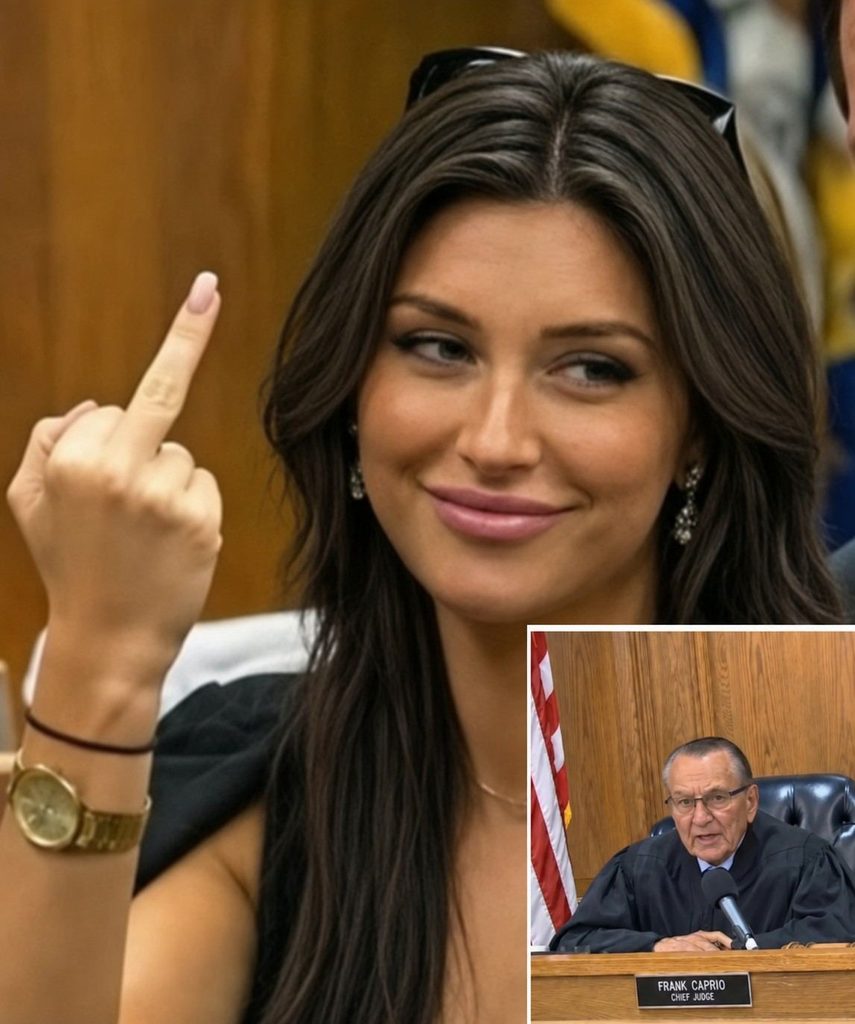
“Good morning, everyone. Please be seated.”
The courtroom slowly became quiet.
The judge looked down at the thick case file in front of him, then raised his eyes toward the young woman sitting beside her attorney.
“In all my years on this bench, I’ve seen just about everything you can imagine,” he began.
“But every once in a while, a case comes through these doors that reminds me why I still come to work every day.”
He paused.
“This courtroom is a place of respect. It is a place where we seek justice, but we do it with dignity, compassion, and fairness.”
Then his voice became firmer.
“I don’t care whether someone is rich or poor.”
“I don’t care what their last name is.”
“And I don’t care who their father is.”
“In this courtroom, everyone is equal under the law.”
The young woman before him was 23 years old.
Her name was Madison Elizabeth Thornton.
She came from an extraordinarily wealthy family.
Her father, Robert Thornton, was the CEO of Thornton Industries, one of the largest real-estate development companies in Rhode Island, reportedly valued at more than $400 million.
But the judge made something clear immediately.
Her father’s wealth was not the reason she was standing before him.
Her own actions were.
Three months earlier, on August 15, 2024, at approximately 4:30 in the afternoon, Madison had been driving a white 2024 Range Rover Sport worth more than $120,000.
She was traveling through the Elmwood neighborhood in Providence.
The posted speed limit was 25 mph.
According to the case presented to the court, Madison was doing approximately 70 mph.
Not on an empty highway.
Not on a private road.
On Cranston Street, between Haskins Avenue and Broad Street.
It was a residential neighborhood.
Children played outside.
Families walked their dogs.
Older residents crossed the street to collect their mail.
At the intersection of Cranston Street and Haskins Avenue, Officer Daniel Martinez pulled Madison over.
Officer Martinez had served with the Providence Police Department for 18 years.
He approached Madison’s vehicle at approximately 4:37 p.m.
He asked the normal question:
“Do you know why I pulled you over?”
According to the police report, Madison’s answer was immediate.
“Do you know who my father is?”
Then she added:
“He owns half the city. I can have your badge by tomorrow morning.”
When the judge first read those words in the report, he said he had to put the papers down.
Because to him, those few sentences revealed something much more troubling than a speeding violation.
It was the attitude behind them.
The belief that money, privilege, and a powerful family name could somehow place a person above consequences.
Officer Martinez remained professional.
He explained how serious the speeding violation was.
He explained that traveling at that speed through a residential neighborhood could put other people in danger.
Madison didn’t respond with an apology.
According to the report, she laughed.
Then she pulled out her iPhone and began recording the officer.
She told him she was going to make him “famous.”
Officer Martinez could have become emotional.
He didn’t.
At approximately 4:49 p.m., he issued Madison three citations.
Citation 2428847.
Citation 24-28848.
Citation 24-28849.
They were issued for reckless driving, excessive speeding, and creating a public hazard.
Everything was documented.
For most people, receiving those citations would have been the moment to stop.
To think.
To reconsider their behavior.
But the story didn’t end there.
Later that evening, Madison posted videos of Officer Martinez to her Instagram account, where she had more than 47,000 followers.
The posts were later submitted as evidence.
She mocked the officer.
She called him names.
She referred to him as a “rent-a-cop” and a “power-tripping nobody.”
One of the videos received more than 12,000 views within 24 hours.
But even that wasn’t the part that concerned the judge most.
Three days later, on August 18, 2024, at approximately 2:15 in the afternoon, a Ring doorbell camera belonging to a family in the same neighborhood captured a familiar vehicle.
The same white Range Rover.
The same driver.
And according to the case, the same reckless behavior.
Madison had been stopped.
She had received citations.
She had been warned.
She had publicly mocked the officer.
And just three days later, she was allegedly doing it again.
That second incident changed the judge’s view of the entire case.
He had spent 32 years on the bench.
During that time, he had seen teenagers make foolish mistakes.
He had seen young people make terrible decisions and then walk into his courtroom genuinely ashamed.
He had seen people from difficult backgrounds make errors in judgment.
And many times, he had shown mercy.
He had reduced penalties.
He had ordered community service instead of more severe punishment.
He believed in second chances.
He believed people could change.
But he also believed in accountability.
“When someone demonstrates a pattern of behavior showing complete disregard for the law and the safety of others,” he said, “this court has an obligation.”
An obligation to protect the community.
And an obligation to make it clear that nobody is above the law.
Then the judge revealed another part of the case.
Something had happened after Madison was charged.
Her father, Robert Thornton, had reportedly begun using his connections.
Between August 20 and September 5, the judge said his chambers received seven phone calls.
There were also four written letters.
Several influential people had allegedly approached the situation.
Among them were individuals connected to business, politics, and the local community.
The message was never stated quite the same way.
But the suggestion was similar.
Maybe something could be worked out.
Maybe Madison had already learned her lesson.
Maybe the family could make a generous charitable donation.
Amounts between $50,000 and $75,000 were reportedly discussed.
The judge looked across the courtroom.
Then he spoke slowly.
“Let me be crystal clear.”
“I don’t care how much money someone has.”
“I don’t care how many buildings they own.”
“I don’t care how many people they employ.”
“And I don’t care whether they are willing to donate $50,000 or $500,000.”
“Money does not buy justice in this courtroom.”
Madison’s expression changed.
Her father remained seated behind the defense table.
The judge continued.
“Influence does not buy a pass on consequences.”
No donation, phone call, connection, or private arrangement was going to determine what happened in that courtroom.
The judge then spoke about the people Madison could have affected.
The families living along Cranston Street.
The parents whose children played outside.
Older residents who crossed the street.
He mentioned 72-year-old Dorothy Henderson and her 74-year-old husband, Frank, both retired teachers.
According to the case, they had been crossing the street on August 15 when Madison’s SUV came through the neighborhood.
They had to move quickly back toward the curb.
Fortunately, nobody was injured.
That fact mattered enormously.
But the judge kept returning to one question.
What could have happened?
What if a child had stepped into the street?
What if an older resident had been halfway across?
What if someone had been standing near the road at the wrong moment?
The courtroom became quiet.
The judge had grandchildren himself.
He spoke about imagining one of them playing outside while a vehicle came through a residential neighborhood at 70 mph.
That was why, he explained, this was no longer simply about a traffic ticket.
The court then considered sentencing recommendations.
Assistant District Attorney Sarah Chen asked the court to impose a substantial penalty.
The prosecution recommended:
A $10,000 fine.
A two-year license suspension.
150 hours of mandatory community service.
And 90 days of incarceration.
Madison’s defense attorney, Jennifer Morrison, argued for leniency.
She reminded the court that Madison had no previous criminal record.
She was 23 years old.
She had graduated from Moses Brown School in 2019 and Boston University in 2023 with a degree in marketing and communications.
Her attorney argued that an extremely harsh sentence could damage her future career.
The defense suggested:
A $3,000 fine.
And 80 hours of community service.
The judge listened to both sides.
He reviewed the police reports.
He reviewed the videos.
He reviewed the social-media posts.
He watched the doorbell footage from the second incident.
Then he looked at Madison.
“What troubles me most about this case isn’t even the speeding.”
Madison looked up.
“It isn’t even the reckless behavior.”
He paused.
“It is the attitude.”
“The arrogance.”
“The complete lack of understanding that your actions affect other people.”
That was the issue he kept returning to.
The first incident could have been a mistake.
But then came the conversation with the officer.
The social-media videos.
The public mockery.
And finally, the second incident just three days later.
To the judge, that suggested Madison had either failed to understand the seriousness of what happened…
Or understood it perfectly and simply believed nothing meaningful would happen to her.
“Not today,” the judge said.
“Not in this courtroom.”
He then explained what sentencing was supposed to accomplish.
Punishment was one part of it.
Deterrence was another.
Protecting the community mattered.
And courts also had a responsibility to send a message that certain behavior had real consequences.
In many cases, he said, he could balance those goals with mercy.
But mercy required remorse.
He looked directly at Madison.
“I don’t see genuine remorse here.”
“What I see is someone who believes she is untouchable.”
Her attorney had argued that Madison had no criminal record.
The judge acknowledged that.
Then he made another point.
“Most 23-year-olds don’t have criminal records.”
“That isn’t extraordinary.”
“That is the minimum expectation of a law-abiding citizen.”
The defense had also emphasized Madison’s age.
Again, the judge understood.
Young adults make mistakes.
They don’t always think through consequences.
But at 23 years old, he said, Madison was old enough to vote.
Old enough to sign contracts.
Old enough to marry.
And certainly old enough to understand that driving 70 mph in a 25-mph residential zone was dangerous.
She was also old enough to understand that threatening a police officer with her father’s influence was wrong.
And old enough to understand that publicly humiliating someone online was not acceptable.
Most importantly, she was old enough to understand that after getting stopped on August 15, she should not repeat the same behavior on August 18.
The judge closed the folder.
Then he said the words everyone had been waiting for.
“So here is what I have decided.”
Madison’s attorney leaned closer to her.
The courtroom became completely silent.
The judge explained that he had considered everything.
The prosecution’s recommendation.
The defense request.
Madison’s age.
Her background.
Her lack of a previous criminal record.
And the repeated behavior.
Then he began reading the sentence.
“On the charge of reckless driving from August 15, 2024, citation number 2428847, I am imposing the maximum penalty allowed under Rhode Island General Law 1191.”
Madison stared at him.
“Ninety days.”
The courtroom reacted immediately.
But the judge wasn’t finished.
“On the charge of attempting to intimidate a law-enforcement officer under Rhode Island General Law 11 to 37-7, I am adding another 60 days.”
Madison’s face went pale.
Her attorney whispered something.
Then came the second reckless-driving incident from August 18.
Another 90 days.
And these sentences, the judge explained, would be served consecutively rather than concurrently.
He added them together.
90 days.
60 days.
Another 90 days.
A total of:
240 days.
Approximately eight months.
Madison stopped smiling.
The judge continued.
She would serve the sentence at the women’s division of the Adult Correctional Institutions.
Her reporting date was set for December 2, 2024, at 9:00 a.m.
Then came the financial penalty.
The judge imposed a $15,000 fine, payable within 60 days.
The money, according to the sentence described in court, would be divided into three equal portions.
$5,000 for a Rhode Island reckless-driving victims fund.
$5,000 for a Providence public-school safe-streets education program.
And $5,000 for Providence Police community outreach and training programs.
Then came her driver’s license.
Suspended.
Not for six months.
Not for one year.
Not even two.
Three full years.
Beginning November 27, 2024, and ending November 27, 2027.
When the suspension ended, Madison would be required to retake both the written examination and the practical driving test.
She would also have to complete at least 30 hours of driver-safety education.
And there was more.
200 hours of community service.
The judge wanted that service performed with organizations connected to road safety or families affected by serious traffic incidents.
He wanted Madison to understand that reckless driving had consequences beyond fines and paperwork.
The judge looked around the courtroom.
“I can see the shock on your faces.”
Some people probably thought the sentence was too harsh.
Others probably thought it wasn’t harsh enough.
But the judge explained his reasoning.
Madison needed consequences that her father’s wealth could not simply erase.
Consequences that lawyers could not negotiate into something meaningless.
Consequences she would actually remember.
Eight months, he said, was a significant amount of time.
Long enough to think.
Long enough to understand.
But not so long that her entire future would disappear.
Madison would still be only 24 when the sentence was complete.
She would still have opportunities.
She could still build a career.
She could still change.
And that, the judge explained, was the point.
This was not supposed to define the rest of her life.
It was supposed to change the direction of it.
The judge then addressed parents who might hear about the case.
Teach your children respect, he said.
Teach them that wealth and status do not make them better than other people.
Teach them that the people they meet in uniform are still human beings deserving basic dignity.
Because if children grow up believing that rules apply only to other people, eventually they may learn the lesson somewhere much less forgiving.
Finally, the judge looked directly at Madison.
“You are 23 years old.”
“You have your whole life ahead of you.”
“This does not have to define you.”
Eight months later, she could walk out angry.
She could blame the judge.
She could blame Officer Martinez.
She could blame the system.
Or she could decide that the experience had taught her something.
She could develop humility.
Empathy.
Responsibility.
“I hope you make the right choice,” the judge said.
“Because I don’t want to see you back here five or ten years from now.”
Then he turned toward Officer Martinez.
He thanked the officer for his 18 years of service.
He thanked him for remaining professional during the confrontation.
And he thanked him for refusing to allow Madison’s behavior to provoke him.
Before adjourning the court, the judge delivered one final message.
“The law applies to everyone.”
“Justice is blind to wealth, status, and family connections.”
“If you have advantages in life, those advantages come with responsibilities.”
“They are not a license to treat other people poorly.”
Madison sat silently beside her attorney.
The confident smile she had carried into the courtroom was gone.
Her father’s company was still worth hundreds of millions.
His connections had not disappeared.
Her expensive SUV still existed.
But none of those things could change what had just happened.
The judge looked toward the bailiff.
“This court is adjourned.”
And for the first time since the case began, Madison seemed to understand the lesson the judge had been trying to deliver all morning:
Money can buy comfort.
Influence can open doors.
A powerful last name can attract attention.
But none of those things are supposed to place someone above the law.


.jpg)


0 commentaires:
Enregistrer un commentaire