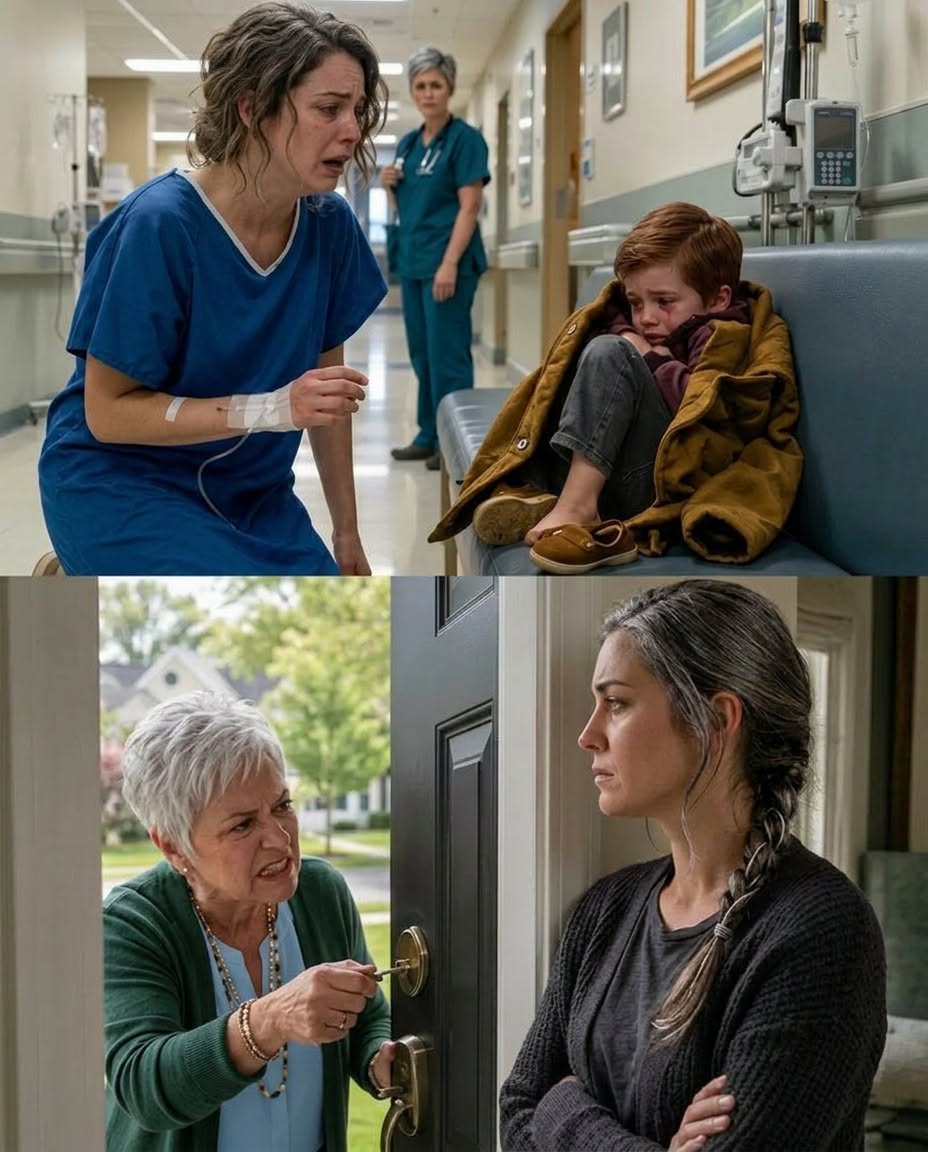
I woke up from surgery to find my four-year-old son abandoned on a hospital bench, crying into my coat. When I called my mother, she didn’t panic. She laughed and said, “Your sister needed us more.” That night, with stitches still burning, I changed every lock on my house. But the real nightmare began the next morning—when she returned with her old key, certain it would still open my door.
I Woke Up from Surgery to Find My Four-Year-Old Son Abandoned on a Hospital Bench, Crying Into My Coat. When I Called My Mother, She Didn’t Panic. She Laughed and Said, “Your Sister Needed Us More.” That Night, I Changed Every Lock on My House. The Next Morning, She Returned with Her Old Key—Certain It Would Still Open My Door.
When I opened my eyes after surgery, everything felt blurry.
The bright hospital lights stung my eyes, and my abdomen burned every time I breathed. A nurse noticed I was awake and smiled. Welcome back,” she said gently. “Your procedure went well.”
The first thing I asked wasn’t about the surgery.
“Where’s my son?”
Four-year-old Noah had been coloring beside my hospital bed before they wheeled me into the operating room. My mother had promised she’d stay with him until I woke up.
The nurse hesitated.
“I thought he was with your family.”
My heart skipped.
“No…my mother was supposed to be here.”
Within seconds, panic spread through the room.
A nurse hurried into the hallway while another tried to reassure me.
“Please stay calm. We’ll find him.”
Calm?
My child was missing.
Ignoring the pain tearing through my stitches, I slid off the bed.
Every movement felt like fire, but adrenaline drowned out the pain.
I shuffled into the hallway, gripping the IV pole for support.
Then I heard it.
A tiny sob.
At the far end of the waiting area sat Noah.
Curled up alone on a hard plastic bench.
My coat was wrapped around his little shoulders.
His cheeks were stained with tears.
The moment he saw me, he ran.
“Mommy!”
I knelt despite the agony, pulling him into my arms.
He clung to me so tightly I could barely breathe.
“I was scared,” he whispered.
“I know, sweetheart.”
The nurse looked horrified.
“We thought someone was with him.”
“So did I.”
One Phone Call Changed Everything
As soon as we returned to my room, I called my mother.
She answered on the second ring.
“Oh, you’re awake.”
“Where is everyone?” I demanded.
A pause.
Then she laughed.
“Your sister needed us more.”
I couldn’t believe what I’d heard.
“What do you mean she needed you more?”
“She called because she wanted help shopping for furniture. You were asleep anyway.” You LEFT my four-year-old alone in a hospital.”
“He wasn’t alone. There were nurses everywhere.”
“They’re hospital staff—not babysitters!”
She sighed dramatically.
“You always overreact.”
I looked at Noah, who had fallen asleep in the chair beside me, still clutching my coat.
Something inside me changed.
Not anger.
Clarity.
Going Home
The hospital discharged me later that evening.
My neighbor drove us home after hearing what had happened.
Before I even stepped inside, I called a locksmith.
He replaced every lock on every door.
Then I changed the garage code.
Updated the alarm system.
Removed my mother’s spare key from the emergency contacts.
For years, she’d treated my home like it belonged to her.
Walking in without knocking.
Rearranging furniture.
Helping herself to groceries.
Criticizing my parenting.
I’d tolerated it because she was family.
Not anymore.
The Morning Knock
At exactly 8:15 the next morning, someone tried to unlock the front door.
Click.
Click.
Click.
Then came frustrated rattling.
I looked through the peephole.
My mother.
She frowned at the lock before trying again.
Nothing.
Finally she knocked.
“Lena! Your key doesn’t work!”
I opened the door just enough to speak through the security chain.
“I know.”
She blinked.
“What do you mean, you know?”
“I changed the locks.”
Her smile disappeared.
“You WHAT?”
“I changed every lock in this house.”
She folded her arms.
“That’s ridiculous.”
“No.”
“It was necessary.”
She laughed as though I’d made a childish joke.
“Come on. Open the door.”
“No.”
The single word stunned her.
“I said open this door.”
“And I said no.”
Years of Favoritism
She launched into a familiar speech.
“Family doesn’t shut each other out.”
I almost laughed.
“Family doesn’t abandon a four-year-old in a hospital either.”
“Your sister had an emergency.”
“Buying a couch isn’t an emergency.”
“She was overwhelmed.”
“So was I. I was unconscious.”
She looked genuinely offended.
“I raised you better than this.”
“You raised me to believe my needs always came second.”
Silence.
I continued.
“When I graduated college, you skipped the ceremony because my sister wanted to go to the beach.”
“You missed Noah’s third birthday because she needed help painting her apartment.”
“You borrowed money I’d saved for a down payment because she wanted a destination wedding.”
“And yesterday you left my child alone.”
She opened her mouth.
Closed it.
Opened it again.
“I didn’t think it was that serious.”
“I know.”
“That’s the problem.”
The Unexpected Visitor
Later that afternoon, my sister arrived.
For once, she wasn’t defensive.
She looked embarrassed.
“I didn’t know Mom left Noah alone.”
“You didn’t?”
She shook her head.
“She told me you’d asked her to come.”
I stared.
“What?”
“When I found out the truth, I drove here immediately.”
She looked down.
“I’m sorry.”
For the first time in years, I realized something important.
My mother had been manipulating both of us.
She constantly told each daughter a different version of events.
Creating competition.
Resentment.
Guilt.
Keeping herself at the center. Over the next few weeks, my sister and I talked honestly for the first time in years.
We compared stories.
Dates.
Phone calls.
Promises.
The pattern became obvious.
Our mother had played us against each other for decades.
Recognizing that didn’t erase the hurt.
But it helped us stop blaming one another.
Instead, we started rebuilding our relationship.
Slowly.
Carefully.
One honest conversation at a time.
The Best Decision I Ever Made
Months later, Noah asked a simple question.
“Grandma doesn’t come over anymore?”
I smiled gently.
“No, sweetheart.”
“Why?”
“Because our home is where people make each other feel safe.”
He nodded as though that explained everything.
Maybe it did.
Changing the locks wasn’t about keeping someone out.
It was about protecting the peace inside.
Sometimes the strongest act of love isn’t opening your door.
It’s deciding who no longer gets a key.
Final Thoughts
Setting boundaries with family is one of the hardest things a person can do. But love should never require sacrificing your safety, your dignity, or your child’s well-being. The day I changed those locks, I wasn’t ending my family—I was choosing a healthier future. And as painful as that choice was, it became the first step toward giving my son the secure, peaceful home he deserved.


0 commentaires:
Enregistrer un commentaire