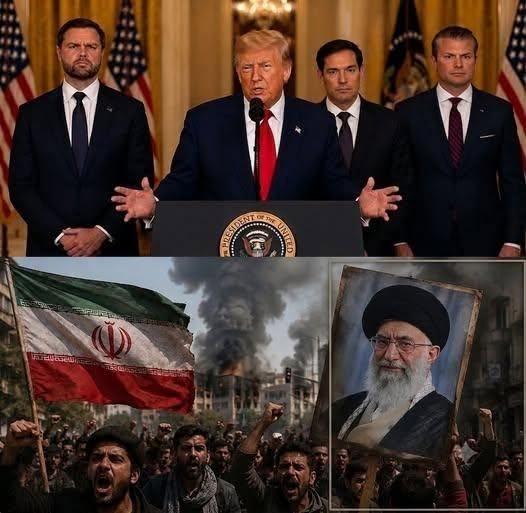
 BREAKING NEWS: TRUMP ANNOUNCES THAT IRAN HAS … See more
REAKING: Trump Announces New Position on Iran as Pressure Intensifies
The confrontation between the United States and Iran has entered another tense and uncertain stage after President Donald Trump indicated that Washington is not currently engaged in negotiations with Tehran, while his administration continues to increase economic pressure on the Iranian government.
The latest development comes as the conflict approaches the six-month mark and as diplomatic efforts to find a lasting settlement remain stalled.
For weeks, international attention has focused on the possibility that the United States and Iran could return to negotiations. Earlier developments had created hopes that the two countries might eventually reach an agreement covering the conflict, the Strait of Hormuz and Iran’s nuclear program.
Those hopes have now been tempered.
Trump has said that the United States is not in a hurry to end the conflict and that Washington is prepared to continue applying pressure. White House officials have similarly said that there are currently no negotiations taking place and that the administration will continue its campaign until Iran approaches the United States in what Washington considers a meaningful way.
The result is a dangerous diplomatic stalemate.
Neither side appears ready to accept the other’s current conditions, while regional governments are increasingly concerned that the confrontation could continue for months or even expand.
Trump Says Washington Is Not in a Hurry
Trump’s latest comments represent a significant shift from earlier moments when he publicly suggested that an agreement with Iran might be close.
At several points during the conflict, the president indicated that negotiations could produce a deal.
There were moments when officials appeared optimistic that a diplomatic breakthrough was possible.
But those efforts repeatedly stalled.
Now Trump is emphasizing pressure rather than immediate negotiations.
The administration argues that Iran is facing severe economic difficulties and that increasing those pressures could eventually force Tehran back to the negotiating table.
Trump has also made clear that he does not believe Washington needs to rush into an agreement.
That position is important because negotiations often depend on timing.
A government that believes it has the stronger position has less incentive to compromise quickly.
The Trump administration appears to believe that continued economic pressure will improve Washington’s negotiating position.
Iran, however, has rejected the American approach and has described the economic campaign as a form of economic warfare.
That fundamental disagreement remains one of the biggest obstacles to diplomacy.
The Conflict Has Become a Long-Term Crisis
When the conflict began, many observers expected military operations to last only a limited amount of time.
Instead, the confrontation has continued for months.
onsiderably since the first major U.S.-Israeli strikes.
Military operations have been followed by diplomatic initiatives, temporary pauses, threats of renewed attacks, economic sanctions and repeated attempts to reopen discussions.
The Strait of Hormuz has become one of the most important flashpoints.
The waterway is strategically vital because of its importance to international energy shipments.
Any prolonged disruption has consequences that extend far beyond Iran and the United States.
Oil markets respond to uncertainty.
Shipping companies face higher risks.
Insurance costs can rise.
Governments become concerned about energy supplies And consumers around the world can eventually feel the consequences through higher transportation and energy costs.
This is one reason international governments are so focused on preventing the conflict from escalating further.
The Strait of Hormuz Remains at the Center
The latest developments surrounding the Strait of Hormuz have added another layer of complexity.
Iran has maintained significant influence over the waterway, while the United States has continued military and economic pressure aimed at changing Tehran’s calculations.
A temporary shipping arrangement involving Iran and Oman was recently announced, reflecting efforts to create at least some room for maritime movement.
But the situation remains fragile.
A tanker was reportedly attacked in the Strait, although authorities said there were no reported casualties or environmental damage.
Every such incident increases concern.
Even when an attack does not produce casualties, it can raise insurance costs and make shipping companies more reluctant to operate in the area.
The Strait therefore represents much more than a geographic location.
It has become a symbol of the larger struggle between Washington and Tehran.
For the United States, keeping international shipping routes open is a major strategic objective.
For Iran, control and sovereignty over the waterway are closely connected to national security and political independence.
That makes compromise especially difficult.
Economic Pressure Becomes Washington’s Main Focus
The Trump administration is increasingly emphasizing economic measures.
Officials say the goal is to place enough pressure on Iran that its leadership eventually decides that negotiation is preferable to continued confrontation.
The White House has described the campaign as a major effort to weaken Iran economically.
Treasury Secretary Scott Bessent has also warned countries and companies that continue financial dealings with Iran that they could face consequences from Washington.
This strategy is designed to reach beyond Iran itself.
The United States wants other governments and businesses to think carefully before maintaining economic relationships with Tehran.
But such a strategy also creates diplomatic complications.
Countries that depend on trade with Iran may resist American pressure.
Some governments argue that unilateral U.S. sanctions should not automatically apply to their own economic policies.
Pakistan, for example, has said it is not obligated to comply with unilateral American sanctions unless they are imposed through the United Nations.
That illustrates the broader challenge facing Washington.
Economic pressure can be powerful, but it is much more difficult when other major countries refuse to cooperate.
Iran Refuses to Simply Give In
Iran faces enormous economic and military pressure, but Tehran has not signaled that it is prepared to accept Washington’s demands without conditions.
Iranian leaders continue to emphasize sovereignty and resistance to outside pressure.
From Tehran’s perspective, agreeing to an American settlement while under military and economic pressure could create serious political consequences.
Iranian officials would have to convince their own population and political factions that any agreement protects the country’s interests.
That is not an easy task.
Iran also has its own expectations.
Those could include sanctions relief, guarantees against future attacks and recognition of Iranian interests in the Strait of Hormuz.
The more conditions each side adds, the more difficult it becomes to construct a compromise.
That is why the current stalemate could continue.
Why Earlier Negotiations Failed
The United States and Iran have already explored possible agreements during the conflict.
At one point, the two sides reached a memorandum of understanding that was intended to create a framework for further discussions.
The agreement was supposed to address major issues, including the Strait of Hormuz, Iran’s nuclear program and the broader conflict.
But the arrangement did not produce a lasting settlement.
Military activity continued.
Disagreements returned.
And eventually the diplomatic process stalled.
The failure demonstrated how difficult it is to negotiate while military operations are still occurring.
Each side worries that concessions could weaken its position.
Each side also questions whether the other can be trusted to honor an agreement.
That makes every negotiation vulnerable.
A deal may look promising one day and collapse the next.
Trump’s “No Hurry” Message
Trump’s statement that he is not in a hurry to end the war is particularly significant.
It suggests that the administration believes time may work in its favor.
If Iran’s economic problems continue to worsen, Washington may believe Tehran will eventually become more willing to compromise.
But there is another possibility.
Long conflicts can create pressure on the country applying sanctions and military force as well.
The United States is not immune from the costs of a prolonged conflict.
Military equipment is expensive.
Personnel and naval assets must remain deployed.
Munitions have to be replaced.
Bases and infrastructure require maintenance.
And the longer a war continues, the greater the political pressure becomes.
Recent reporting has highlighted concerns about the strain the conflict is placing on U.S. military resources, including the Navy’s budget and stockpiles.
That means Trump’s decision to avoid rushing into negotiations also carries risks.
The administration may believe pressure will eventually force Iran to compromise.
But Iran may instead decide that it can withstand the pressure.
If that happens, the conflict could continue indefinitely.
Political Pressure Inside America
The Iran war is also becoming a major domestic political issue.
As the conflict continues, Americans are asking questions about its cost and purpose.
Some support Trump’s approach, arguing that strong military and economic pressure is necessary to protect U.S. interests.
Others believe the conflict has become too costly and lacks a clear path to resolution.
The political debate has also extended to Congress.
Lawmakers have questioned how much authority the president should have to continue military operations without additional congressional authorization.
This has produced a larger debate about the constitutional balance between the executive and legislative branches.
The issue is not unique to Trump.
Presidents of both political parties have faced criticism when using military force without a formal declaration of war.
But the Iran conflict has brought those questions back into the spotlight.
The longer the war lasts, the more difficult it may become for the administration to avoid sustained congressional scrutiny.
Regional Governments Want an Exit
Perhaps no countries have more reason to want an end to the conflict than Iran’s neighbors.
Gulf states understand how quickly a confrontation involving Iran can affect their security.
They are also vulnerable to disruptions in energy markets and shipping.
That is why countries such as Qatar, Oman and Pakistan have continued diplomatic efforts aimed at reducing tensions.
Qatar’s prime minister recently traveled to Tehran as part of efforts to discuss regional security and maritime issues.
These diplomatic initiatives demonstrate that regional governments are searching for an “off-ramp”—a way for the United States and Iran to reduce tensions without either side appearing to surrender.
That may ultimately be one of the most important parts of the diplomatic process.
Neither Washington nor Tehran wants to appear weak.
A successful agreement may therefore require carefully designed language allowing both governments to claim that their fundamental interests have been protected.
The Nuclear Question Has Not Disappeared
Another major issue remains Iran’s nuclear program.
Even as the conflict has shifted toward economic and maritime pressure, questions about Iran’s nuclear capabilities remain central to the dispute.
The United States has repeatedly emphasized the need to prevent Iran from obtaining a nuclear weapon.
Iran has maintained that its nuclear activities are connected to peaceful purposes while disputing outside demands for unrestricted access.
Recent statements from Iranian officials indicate that nuclear facilities affected by military strikes have not yet been fully secured for international inspection.
That creates another major obstacle.
International inspectors need access to determine what remains, what was damaged and what activities may be continuing.
Without reliable inspections, uncertainty increases.
And uncertainty can encourage governments to make worst-case assumptions.
For Washington, that can mean greater pressure.
For Tehran, it can mean greater concern that inspections are being used as a tool of political pressure.
Once again, the cycle becomes difficult to break.
The Danger of Miscalculation
One of the greatest dangers now is not necessarily that either side deliberately chooses a much larger war.
It is that an unexpected incident could trigger one.
A ship could be attacked.
A missile could hit a sensitive target.
A military aircraft could be shot down.
A regional ally could become involved.
Or a statement could be misunderstood.
In a tense environment, even a limited incident can create pressure for retaliation.
Retaliation can then produce another response.
Within hours, a situation that neither side originally intended could become much larger.
That is why diplomatic communication remains important even when official negotiations are suspended.
Back-channel communication can prevent misunderstandings.
Regional governments can carry messages.
International organizations can provide neutral channels.
The absence of formal talks does not necessarily mean that every form of communication has disappeared.
Could Negotiations Return?
Despite Trump’s current position, diplomacy may eventually return.
Wars often end not because one side suddenly decides to surrender, but because both sides eventually determine that continuing is more expensive than reaching a compromise.
That moment has not yet arrived.
The United States believes continued pressure can improve its position.
Iran believes it can resist and protect its interests.
As long as those calculations remain unchanged, negotiations are likely to remain difficult.
But circumstances can change quickly.
Economic conditions could deteriorate further.
Military costs could rise.
Regional governments could increase pressure for a settlement.
American public opinion could shift.
Iranian political calculations could change.
Any of these developments could create a new opening.
The question is whether both sides would recognize that opening when it appears.
What Trump’s Latest Message Really Means
The most important point from Trump’s latest position is that Washington is not currently treating negotiations as the immediate priority.
Instead, the administration is focusing on pressure.
That pressure is economic, military and diplomatic.
Trump appears to believe that Iran will eventually face a choice: accept a negotiated settlement on terms more favorable to Washington or continue facing increasingly severe consequences.
Whether that strategy succeeds remains uncertain.
It could eventually produce a deal.
It could also prolong the conflict.
The outcome will depend on how much pressure Iran can withstand and how much pressure the United States is willing to maintain.
The World Is Waiting for the Next Move
For now, the situation remains unresolved.
The United States says it is not currently negotiating.
Iran continues rejecting Washington’s pressure campaign.
Regional governments are trying to reopen diplomatic channels.
The Strait of Hormuz remains a major flashpoint.
And the economic consequences of the conflict continue spreading beyond the Middle East.
This is why every new statement from Donald Trump is receiving such intense international attention.
A single announcement could signal a new diplomatic initiative.
It could announce additional sanctions.
It could change the military posture.
Or it could simply reinforce the current strategy.
At the moment, however, there is no clear indication that a comprehensive peace agreement is imminent.
Instead, the latest developments point toward continued pressure and uncertainty.
A Critical Moment for Washington and Tehran
The United States and Iran now face a difficult choice.
Continuing the confrontation may preserve pressure but increase economic, military and political costs.
Returning to negotiations could reduce those risks, but it would require compromises that both sides may currently consider unacceptable.
That is the central dilemma.
Trump believes pressure can produce results.
Iran believes resistance can prevent Washington from dictating the terms of its future.
Regional governments want the conflict to end before it causes even greater instability.
And millions of people are waiting for an outcome that remains impossible to predict.
The next stage of the conflict may therefore depend not only on military strength, but on diplomacy, political calculations and the willingness of both sides to reconsider their positions.
For now, the headline is not that a final peace agreement has been reached.
It is that the confrontation continues, Washington is increasing economic pressure, and the door to diplomacy remains uncertain.
The world is watching closely.
And after six months of conflict, the question is no longer simply how the United States and Iran will fight.
The bigger question is how they will eventually find a way to stop.


0 commentaires:
Enregistrer un commentaire